Modern vehicle braking systems rely on accurate information about wheel movement. Anti-lock braking systems use wheel-speed signals to help identify when a wheel is slowing more rapidly than expected during braking. A tone ring is one component that contributes to this measurement process by providing a repeating pattern that a compatible sensor can detect. Its geometry, material, and position influence the quality of the signal received by the vehicle’s electronic control system.
When specifying ABS Sensor Tone Rings, manufacturers and repair professionals should consider the complete sensing arrangement. The ring must be compatible with the sensor technology, mounting location, vehicle design, and environmental conditions. A component that appears dimensionally suitable may still produce unreliable readings if its tooth pattern, air gap, or installation position is incorrect.
What a tone ring does
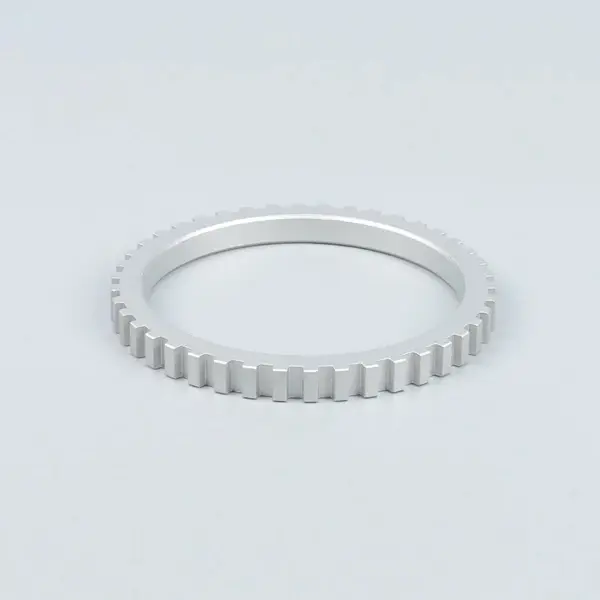
A conventional toothed tone ring rotates with the wheel, axle, hub, or another rotating assembly. As its teeth or regularly spaced features pass the sensor, they create changes in the detected signal. The vehicle’s control electronics interpret these changes to calculate wheel speed.
The exact sensing principle depends on the system. Some arrangements use magnetic or inductive sensing, while others employ encoder rings with a magnetic pattern. These technologies are not interchangeable. The ring and sensor must be designed to work together, and the vehicle manufacturer’s specifications should guide replacement or component selection.
How wheel-speed information supports ABS
During braking, the ABS control unit monitors signals from the wheel-speed sensors. If the system detects a pattern suggesting that a wheel is approaching lockup, it can adjust brake pressure through the hydraulic control unit. This helps maintain wheel rotation and supports steering control during hard braking on suitable surfaces.
The tone ring does not control braking pressure by itself. It supplies a detectable reference pattern that allows the sensor to report rotational movement. Signal quality therefore matters. Damaged teeth, excessive corrosion, incorrect spacing, or poor alignment can affect detection and may contribute to warning lights or system faults.
Design features that matter
A tone ring’s outside diameter, inside diameter, thickness, tooth count, tooth shape, and mounting features should match the intended assembly. The number and spacing of teeth influence the signal frequency generated at a given rotational speed.
Material choice depends on the sensing method and operating environment. Ferromagnetic materials are commonly relevant to certain inductive sensing arrangements, while magnetic encoder designs require an appropriate magnetic pattern and construction. Corrosion resistance, mechanical strength, and dimensional stability are also important because the component operates near road debris, moisture, vibration, and temperature changes.
Mounting accuracy is essential. The ring must remain securely positioned relative to the sensor. The air gap between the sensing element and target should meet the system’s specified range. Too much distance can weaken the signal, while contact or interference can damage the sensor or ring.
Manufacturing considerations
Manufacturing may involve forming, machining, stamping, or other metalworking processes, depending on the ring’s geometry and production requirements. The selected method should produce consistent tooth profiles, concentricity, thickness, and mounting dimensions.
For high-volume programs, repeatability is especially important. Variations in tooth spacing or runout can influence sensor output. Quality checks may include dimensional inspection, profile measurement, material verification, surface examination, and functional testing with a compatible sensor.
If the design uses a magnetic encoder, inspection must also address the magnetic pattern and its consistency. Visual inspection alone cannot confirm that the sensing characteristics are correct.
Common applications
Tone rings are used in passenger cars, commercial vehicles, motorcycles, and other wheeled equipment fitted with compatible electronic speed-sensing systems. Depending on the vehicle architecture, the ring may be located at a wheel hub, axle, bearing assembly, or other rotating component.
Some designs integrate the encoder into a bearing seal or hub assembly rather than using a separate exposed toothed ring. Replacement parts must match the original system configuration.
Installation and maintenance issues
Technicians should inspect the ring and surrounding components for cracks, missing teeth, corrosion, contamination, and physical damage. Sensor wiring, connector condition, mounting security, and the specified air gap should also be checked when diagnosing a fault.
Cleaning should use methods compatible with the ring and sensor. Aggressive tools can damage teeth or magnetic surfaces. Installation procedures should follow the vehicle manufacturer’s guidance, including torque requirements and any specified calibration or diagnostic steps.
Reliability depends on compatibility
An ABS tone ring is a small component with an important role in wheel-speed measurement. Correct geometry, suitable material, stable mounting, and sensor compatibility are essential to dependable operation. Manufacturers should validate the complete sensing arrangement, while technicians should diagnose faults systematically rather than replacing the ring without checking the sensor and installation conditions.