Introduction
Food delivery has become an important part of the restaurant and catering industry. Customers expect their meals to arrive in good condition, with ingredients properly arranged and packaging that is easy to carry and open. For food businesses, choosing the right container is therefore essential for maintaining food quality, improving handling efficiency, and creating a positive delivery experience.
Compartment-based packaging offers a practical solution for meals containing several ingredients. Well-designed Takeaway Bento Boxes help keep different food items organized within one container while supporting convenient transportation. However, not every design provides the same level of protection or functionality. Understanding the essential features can help restaurants select packaging that meets their food safety and delivery requirements.
1. Food-Grade and Safe Materials
Material safety is one of the most important considerations when selecting food packaging. Containers come into direct contact with meals, so their materials must be suitable for the intended food applications.
Food businesses should check whether the packaging complies with applicable food-contact regulations and manufacturer specifications.
Important considerations include:
- Material suitability for hot or cold foods.
- Compliance with relevant food-contact safety standards.
- Resistance to expected moisture and grease exposure.
- Absence of unsuitable substances that could migrate into food.
- Appropriate storage and handling instructions.
Using suitable food-contact materials helps businesses maintain hygienic packaging practices and reduce potential contamination risks.
2. Secure Lid and Closure Design
A secure closure helps protect meals from dust, accidental contact, and movement during transportation.
Takeaway bento boxes may feature folding flaps, tuck-in closures, attached lids, or separate covers. The appropriate design depends on the container material and intended food application.
A reliable closure should:
- Fit properly without leaving unnecessary gaps.
- Remain secure during normal handling.
- Be easy for customers to open.
- Support convenient stacking when required.
- Maintain its shape under the expected food weight.
For delivery businesses, testing the closure with actual meal portions is important. A container that closes properly when empty may perform differently once filled.
3. Multiple Compartments for Food Separation
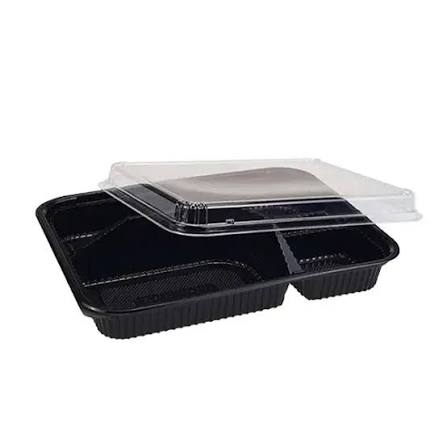
Compartmentalized construction is a defining feature of bento-style packaging.
Separate sections allow restaurants to arrange rice, meat, vegetables, salads, and side dishes within one container. This reduces unnecessary contact between ingredients and helps preserve the intended meal presentation.
For example, a restaurant serving grilled chicken with rice and vegetables can place each component in a designated section.
The number and size of compartments should match the menu. Too many small sections may limit portion flexibility, while oversized compartments can create unnecessary empty space.
4. Strong and Durable Construction
Packaging must withstand the weight of food and the handling involved in delivery.
Weak containers may bend, collapse, or lose their shape when filled with heavier meals. This can create inconvenience for delivery staff and customers.
When evaluating structural strength, businesses should examine:
- Material thickness.
- Base rigidity.
- Sidewall construction.
- Corner strength.
- Lid stability.
- Performance when stacked.
Cardboard and paperboard containers should have sufficient structural support for their intended applications. Plastic and molded fiber alternatives should also be evaluated according to their specific material properties.
5. Moisture and Grease Resistance
Food often contains liquids, oils, sauces, and natural moisture. These elements can affect packaging performance, especially during longer delivery periods.
Paper-based containers may require suitable protective coatings or treatments when used for oily or moist meals.
For example, packaging for fried chicken may need grease resistance, while containers for salads may need to withstand moisture from fresh ingredients.
Businesses should confirm the manufacturer’s specifications rather than assuming every container offers the same level of protection.
6. Leak Protection for Sauces and Liquid Foods
Meals containing curry, gravy, dressings, and other liquids require special attention.
Although divided compartments can separate ingredients, they do not automatically make a container leakproof. Liquid-heavy foods may require dedicated sealed cups or containers.
When selecting packaging for saucy dishes, consider:
- The design of the compartment walls.
- The fit between the lid and container.
- The material’s resistance to liquid exposure.
- The expected delivery duration.
- Whether separate sauce packaging is necessary.
Practical testing with actual menu items can help identify leakage problems before large-scale purchasing.
7. Suitable Temperature Performance
Food delivery packaging should be appropriate for the temperature conditions of the meal.
Some containers are designed for hot foods, while others are intended for chilled or room-temperature applications. Businesses should review the manufacturer’s temperature limits and instructions before using a container.
Important considerations include:
- Whether the material maintains its shape with hot food.
- Whether condensation may affect the packaging.
- Whether the container is suitable for refrigerated storage.
- Whether the product has verified microwave compatibility, if needed.
Microwave and freezer suitability should never be assumed without confirmation from the manufacturer.
8. Convenient Size and Portion Capacity
A well-sized container helps protect food presentation and makes meals easier to handle.
If a bento box is too small, ingredients may become compressed and the lid may not close properly. An oversized container may allow food to move excessively during transportation.
Businesses should select dimensions based on standard meal portions and the number of ingredients included.
Offering different container sizes can also help restaurants accommodate individual meals, large portions, and special menu combinations.
9. Stackability and Storage Efficiency
Restaurants and delivery kitchens often store packaging in limited spaces. Containers that stack neatly can make inventory organization easier.
Stackable bento boxes can help businesses arrange empty packaging in storage areas and transport prepared meals more systematically.
However, stacking performance depends on the container’s shape, lid design, and structural strength.
Before selecting a product, businesses should check whether filled containers can be stacked safely without placing excessive pressure on the food or compromising the closures.
10. Lightweight and Easy-to-Carry Design
Packaging weight influences convenience for restaurant staff, delivery personnel, and customers.
Lightweight containers are easier to handle in large quantities and may be more practical for businesses processing frequent orders.
However, reducing weight should not compromise structural strength. A suitable design should balance lightweight construction with the ability to support the intended meal.
Comfortable handling, stable bases, and practical dimensions can also improve the overall delivery experience.
11. Ventilation and Moisture Management
Certain foods release steam after cooking. If excessive moisture becomes trapped inside a container, it may affect food texture and appearance.
This is particularly relevant for fried foods, baked products, and other meals that are best served with some crispness.
Depending on the menu, ventilation features may help manage steam. However, ventilation must be balanced with the need to protect food from contamination and prevent spills.
Restaurants should select a design according to the specific food rather than assuming that fully sealed packaging is always the best option.
12. Tamper-Evident Packaging Options
Customers want confidence that their meals have remained protected between the restaurant and delivery destination.
Tamper-evident packaging features can help show whether a package has been opened after preparation.
These may include security labels, seals, or specially designed closures.
For restaurants, tamper-evident features can support delivery procedures and improve customer confidence. They should be easy for staff to apply and straightforward for customers to recognize.
13. Easy Assembly and Handling
Packaging should be practical for employees who prepare many orders during busy periods.
Containers that are difficult to fold, assemble, or close may slow down kitchen operations.
Businesses should evaluate how quickly employees can prepare the boxes and whether the design requires additional accessories.
Simple folding structures, clearly defined closures, and consistent dimensions can make packaging easier to manage.
14. Customization and Branding
Food packaging can also help businesses create a consistent brand identity.
Many takeaway bento boxes offer customization options such as printed logos, brand colors, product information, and special designs.
Custom packaging can make restaurant orders more recognizable and create a coordinated appearance across takeaway and delivery services.
When selecting printed containers, businesses should confirm that inks and other packaging components are appropriate for the intended food-contact application.
15. Environmental Considerations
Many food businesses are reviewing packaging materials as part of their environmental responsibilities.
Cardboard and paperboard containers made from responsibly sourced or recycled fibers may support more resource-conscious packaging choices.
However, environmental performance depends on the complete product design. Coatings, plastic laminations, adhesives, and food contamination can affect recyclability.
Businesses should review material specifications and local waste management facilities before describing a package as recyclable, compostable, or biodegradable.
16. Choosing a Reliable Bento Box Supplier
The quality of packaging depends not only on its design but also on the consistency of the manufacturer.
When comparing suppliers, food businesses should evaluate:
- Product specifications and material options.
- Manufacturing quality control procedures.
- Customization and printing capabilities.
- Sample availability.
- Production capacity.
- Minimum order quantities.
- Delivery schedules and communication.
Requesting product samples is particularly useful because it allows buyers to test packaging with real food before placing bulk orders.
Businesses exploring different packaging designs can also review the bento box options offered by Uchampak when comparing material choices, dimensions, and customization requirements.
17. Test Packaging Before Large Orders
Even a container with suitable specifications should be tested under actual operating conditions.
A practical testing process can help identify problems that may not be visible from product descriptions alone.
Consider checking:
- Whether the container supports the standard meal portion.
- Whether the lid closes securely after filling.
- Whether moisture or grease affects the material.
- Whether different ingredients remain properly separated.
- Whether the container maintains its shape during stacking.
- Whether the packaging performs well during a typical delivery journey.
These checks help businesses make informed purchasing decisions and reduce the risk of packaging failures.
Conclusion
The right takeaway bento box should combine food safety, structural strength, secure closures, suitable compartment design, and convenient handling. Features such as moisture resistance, temperature compatibility, appropriate sizing, and tamper-evident options can further support reliable food delivery.
Restaurants and catering businesses should evaluate packaging according to their menu, delivery conditions, and operational needs. By testing samples and working with a dependable supplier, they can choose containers that protect meals, maintain presentation, and provide a convenient experience for customers.