

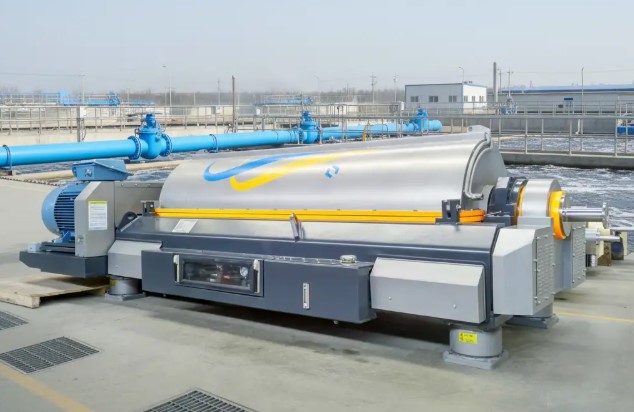
Solid-liquid separation plays an important role in many industrial processes. Manufacturers use different technologies to remove solids from liquids, concentrate slurries, or recover valuable materials from process streams.
A centrifuge separator relies on centrifugal force, while a filter press uses pressure and a filter medium to separate solid particles from liquid. Although both technologies target solid-liquid separation, their operating methods, equipment designs, and suitable applications differ considerably.
How Does a Centrifuge Separator Work?
A centrifuge separates materials by rotating a mixture at high speed. The resulting centrifugal force causes denser solid particles to move away from the center of rotation.
The liquid remains closer to the central region and exits through a separate outlet. Depending on the equipment design, separated solids can also discharge continuously.
This operating principle makes centrifugal equipment suitable for processes that require continuous separation and consistent material flow.
How Does a Filter Press Work?
A filter press uses a series of filter plates and filter cloths to separate solids from liquids. A slurry enters the press, and pressure pushes the liquid through the filter medium.
Solid particles remain on the filter cloth and gradually form filter cakes between the plates. Once the filtration cycle finishes, operators open the press and remove the accumulated cakes.
Unlike many continuous centrifugal systems, a conventional filter press generally operates through repeated filtration cycles.
Key Difference in Operating Principle
The biggest difference involves the force used to achieve separation.
A centrifuge uses rotational force to accelerate the movement of dense particles. A filter press uses mechanical pressure to force liquid through a porous filtration medium.
These different principles affect processing speed, solids handling, equipment footprint, maintenance, and the characteristics of the final separated materials.
Centrifuge vs. Filter Press at a Glance
| Feature | Centrifuge | Filter Press |
| Separation method | Centrifugal force | Pressure filtration |
| Operation | Often continuous | Generally batch-based |
| Filter medium | Usually not required | Filter cloth required |
| Solids handling | Can support continuous discharge | Filter cake removal required |
| Liquid recovery | Suitable for continuous clarification | Depends on filtration cycle |
| Automation potential | High | Moderate to high |
| Floor space | Often compact | Requires space for plate handling |
| Maintenance | Focuses on rotating components | Includes cloths, plates, seals, and pumps |
The best option depends on the material, production requirements, desired separation results, and facility conditions.
When Is a Centrifuge a Better Choice?
Centrifugal equipment may provide advantages when a plant needs continuous processing. The machine can separate incoming material while maintaining a steady production flow.
It can also suit applications where fine suspended particles need rapid separation. The strong centrifugal force can accelerate particle migration compared with gravity-based settling.
A centrifuge may also make sense when floor space remains limited or when automated processing represents an important production goal.
When Does a Filter Press Make More Sense?
A filter press can work well when the process requires high solids capture and relatively dry filter cakes.
The technology suits applications where batch processing does not create a significant production limitation. It also provides flexibility when operators need to inspect or handle the separated solids after each filtration cycle.
Filter presses can accommodate various filter cloth configurations, allowing manufacturers to adjust filtration performance for different slurry characteristics.
Difference in Solids Dryness
The moisture content of separated solids can influence equipment selection. A filter press often produces a relatively dry filter cake because the slurry undergoes pressure filtration.
Centrifugal equipment can also concentrate solids effectively, but the final moisture level depends on machine configuration, feed properties, operating conditions, and residence time.
Manufacturers should define their target solids concentration before choosing between the two technologies.
Difference in Liquid Clarification
Both systems can produce clarified liquid, but their performance depends on particle size and material characteristics.
Centrifuges can provide continuous clarification for suitable feed streams. Filter presses rely on the filter medium to retain solid particles while allowing liquid to pass through.
Very fine particles may require careful filter cloth selection in a filter press, while centrifugal systems depend more heavily on density differences and operating conditions.
Maintenance Requirements
Maintenance requirements differ because the two technologies contain different mechanical components.
Centrifugal equipment requires attention to rotating parts, bearings, drive systems, seals, vibration, and other high-speed components.
Filter presses require inspection of filter cloths, plates, seals, hydraulic systems, pumps, and related components. Filter cloth condition can directly affect filtration performance.
Energy and Operating Considerations
Energy consumption depends on the equipment size, operating conditions, feed characteristics, and production requirements.
A centrifuge may consume significant mechanical energy because it operates at high rotational speeds. However, continuous operation can reduce interruptions associated with repeated batch cycles.
A filter press may require energy for slurry pumping and plate closing, while operators also need to account for cycle time and solids cake removal.
A meaningful comparison should therefore consider total operating costs rather than energy consumption alone.
Installation and Space Requirements
Available floor space can influence the decision. Centrifugal systems often provide a compact separation solution relative to their processing capacity.
Filter presses require sufficient room for plate opening, filter cake removal, cloth inspection, and maintenance activities.
Plant layout should include access for operators and maintenance personnel, not just the equipment’s basic footprint.
Automation and Labor
Automation can make a major difference in high-throughput facilities. Many centrifugal systems support automated feed control, solids discharge, and monitoring functions.
Traditional filter presses may require more operator involvement during cake removal and equipment cleaning, although automated filter press systems can reduce manual tasks.
The appropriate level of automation depends on production volume, labor availability, and process requirements.
How Shenzhou Machinery Approaches Separation Equipment
Shenzhou Machinery provides separation equipment for industrial processing applications. Equipment selection should start with the material being processed rather than simply choosing between two technologies based on general specifications.
Manufacturers should evaluate feed composition, solids concentration, particle size, required capacity, desired liquid clarity, solids dryness, and available installation space.
These factors help determine whether centrifugal separation or pressure filtration offers the more practical solution.
Which Technology Should You Choose?
There is no universal winner between a centrifuge and a filter press. Each technology has characteristics that make it suitable for particular applications.
Consider a centrifuge when continuous processing, compact installation, automated operation, or rapid separation represents a priority.
Consider a filter press when high solids capture, dry filter cakes, and batch processing fit the production requirements.
Before purchasing equipment, manufacturers should test representative material whenever possible. Process testing provides more reliable information than comparing specifications alone.
Conclusion
The main difference between a centrifuge separator and a filter press lies in how each machine separates solids from liquids. A centrifuge uses centrifugal force, while a filter press relies on pressure and a filtration medium.
Centrifugal systems often suit continuous, automated processes, while filter presses can provide strong solids capture and relatively dry filter cakes in batch applications.
Shenzhou Machinery can help manufacturers evaluate separation requirements and identify equipment options suited to their specific processes. Careful assessment of feed characteristics, production targets, maintenance needs, and installation conditions can lead to a more effective separation solution.


