Modern checkout environments require more than a screen and a payment interface. Businesses expect POS devices to be fast, reliable, durable, and easy for employees to use throughout long operating hours. As customer expectations evolve, hardware development has become an important part of creating efficient point-of-sale experiences.
A professional POS Hardware Manufacturer typically considers multiple factors when developing checkout devices, from component selection and system compatibility to ergonomics and long-term reliability. Understanding this development process can help businesses make more informed decisions when evaluating POS equipment for retail, hospitality, and other commercial environments.
Understanding Modern Checkout Requirements
POS hardware is used in a wide range of environments, and each setting can create different demands. A retail counter may prioritize quick scanning and compact equipment, while a restaurant may require devices that support frequent transactions and easy cleaning.
Manufacturers begin by studying these operational requirements. This helps determine the appropriate screen size, processing capabilities, connectivity options, mounting methods, and peripheral support.
Selecting the Right Hardware Components
The quality of individual components has a direct effect on the performance and lifespan of a checkout device. Manufacturers carefully evaluate processors, displays, memory, storage, ports, power systems, and other internal components.
Component selection must also balance performance with factors such as energy consumption, heat management, physical space, and production costs. The goal is to create equipment that performs consistently without unnecessary complexity.
Designing for Ease of Use
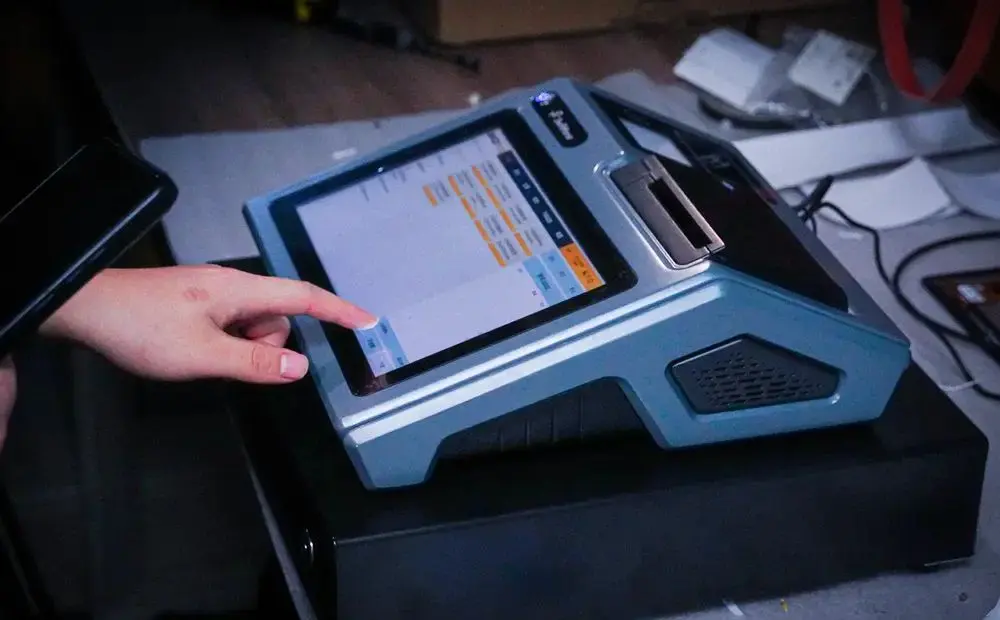
Checkout devices are often operated repeatedly throughout the day, making usability an important design consideration. A well-designed POS terminal should allow employees to complete common tasks without unnecessary steps.
Manufacturers may consider:
- Screen positioning and viewing angles
- Touchscreen responsiveness
- Button and interface accessibility
- Cable management
- Device footprint
- Mounting flexibility
- Accessibility for maintenance
Good ergonomics can reduce operational friction and make checkout workflows easier for employees.
Building for Different Business Environments
Modern POS devices need to accommodate different physical and operational conditions. Equipment used in a busy restaurant, for example, may face different challenges from hardware installed in a clothing store or supermarket.
Manufacturers may develop different form factors and configurations to address these requirements. Countertop terminals, compact systems, customer-facing displays, and integrated peripherals can all serve different purposes within a checkout environment.
Integrating POS Peripherals
A checkout device rarely works alone. Businesses often connect POS terminals with scanners, receipt printers, cash drawers, payment devices, customer displays, and other peripherals.
For this reason, manufacturers consider connectivity during the design process. USB, Ethernet, serial interfaces, wireless technologies, and other connection options can help businesses build complete checkout stations based on their operational needs.
Focusing on Durability
POS equipment can experience thousands of interactions over its service life. Frequent touchscreen use, repeated transactions, cable movement, and exposure to dust or spills can place stress on hardware.
Manufacturers therefore consider enclosure materials, structural design, thermal management, and component durability. Testing can help identify potential weaknesses before devices reach commercial environments.
Testing Performance and Reliability
Testing is a critical stage in the development of modern checkout hardware. Devices may undergo performance checks, connectivity testing, thermal evaluations, and physical durability assessments.
Quality control procedures can help manufacturers maintain consistency across production batches. Reliable testing also provides businesses with greater confidence that equipment will perform as expected in demanding operational settings.
Supporting Software Compatibility
Hardware development increasingly involves consideration of the software that runs on the device. POS systems need to communicate effectively with operating systems, applications, payment technologies, and connected peripherals.
Manufacturers therefore pay attention to drivers, ports, system requirements, and compatibility standards. Hardware that integrates smoothly with existing technology can simplify deployment and reduce potential operational issues.
Considering Maintenance and Serviceability
A checkout device should not only be easy to operate; it should also be practical to maintain. Accessible components and sensible internal layouts can make repairs, upgrades, and replacements more manageable.
Manufacturers may design equipment with service access in mind, helping businesses reduce unnecessary downtime when a component requires attention.
Creating Scalable Hardware Options
Business requirements can change over time. A small retailer may eventually expand to additional locations, while an established business may introduce new checkout stations or services.
Modern POS hardware can be designed with scalability in mind. Flexible connectivity, multiple configurations, and compatible peripherals allow businesses to adapt their checkout infrastructure as operational requirements develop.
Balancing Innovation With Practicality
New technologies can improve checkout experiences, but not every emerging feature is appropriate for every business. Manufacturers must balance innovation with reliability, usability, compatibility, and cost.
The most effective devices are often those that introduce useful improvements without making everyday transactions unnecessarily complicated. Practical design remains essential even as checkout technology continues to advance.
The Importance of Consistent Manufacturing
Developing a successful POS device is only part of the process. Manufacturers also need to maintain consistency when producing equipment at scale.
Standardized production processes, component controls, testing procedures, and quality inspections can help ensure that devices meet expected specifications. Consistency becomes particularly important for businesses deploying POS hardware across multiple locations.
Looking at the Complete Checkout Experience
Modern POS hardware development is not limited to creating an attractive terminal. It involves understanding how employees interact with devices, how peripherals connect, how equipment performs under pressure, and how systems can be maintained over time.
Businesses evaluating checkout equipment should therefore look beyond individual specifications. Factors such as durability, compatibility, usability, serviceability, and scalability can have a significant impact on the overall value of a POS investment.
Conclusion
Modern checkout devices are developed through a combination of engineering, usability planning, component selection, testing, and manufacturing quality control. Each stage contributes to creating hardware that can support dependable day-to-day transactions.
For businesses, understanding how POS equipment is developed makes it easier to evaluate potential solutions. By considering performance, durability, compatibility, maintenance, and future requirements, organizations can choose checkout hardware that fits their current operations while remaining practical as their needs evolve.