Introduction
Phosphorylated tau at threonine 181, commonly referred to as p-tau 181, is an important biomarker in research investigating Alzheimer’s disease and other neurodegenerative processes. Measuring this protein can help researchers explore tau-related biological changes, compare experimental samples, and investigate relationships between different biomarkers. However, obtaining meaningful results requires more than selecting a detection technology. Laboratories must develop a well-defined assay procedure that supports consistent sample handling, reliable detection, and appropriate data interpretation.
Developing a p-tau 181 protocol involves a series of decisions about assay design, sample preparation, reagent selection, calibration, analytical validation, and quality control. Each stage can influence the final measurement, so researchers should establish clear procedures before beginning routine experiments. A structured development process helps laboratories identify potential sources of variation and determine whether the selected method is appropriate for its intended research application.
1. Define the Research Objective
The first step in assay protocol development is identifying what the laboratory wants to investigate.
P-tau 181 may be measured in studies examining Alzheimer’s-related biomarker changes, tau phosphorylation, disease-associated biological processes, or relationships between different molecular indicators.
Before selecting an assay format, researchers should define:
- Primary research question: What biological relationship or experimental outcome will the measurement help investigate?
- Target sample type: Will the study use plasma, serum, cerebrospinal fluid, or another validated sample matrix?
- Expected concentration range: What analyte concentrations are likely to occur in the study samples?
- Required analytical performance: What levels of sensitivity, precision, and specificity are appropriate?
- Study design: Will measurements be performed once, repeatedly over time, or across multiple laboratories?
These decisions establish the requirements against which the assay will be evaluated.
2. Select an Appropriate Assay Technology
Different immunoassay technologies can be used to investigate p-tau 181. The choice depends on sample characteristics, available equipment, analytical requirements, and laboratory resources.
Enzyme-Linked Immunosorbent Assay (ELISA)
ELISA uses antibodies to recognize the target protein and an enzyme-mediated reaction to generate a measurable signal.
Common considerations include:
- Antibody specificity and binding performance
- Plate washing consistency
- Incubation time and temperature
- Substrate development conditions
- Microplate reader performance
ELISA can be useful for laboratories with established microplate workflows and appropriate assay reagents.
Chemiluminescence Immunoassay (CLIA)
Chemiluminescence immunoassays use antibody-based recognition and a chemical reaction that generates light. An appropriate analyzer measures the resulting signal and relates it to analyte concentration through calibration.
Potential advantages of this format include automated processing and standardized signal measurement, depending on the platform.
When developing a CLIA-based procedure, researchers should verify that the p-tau 181 reagent system is specifically compatible with the selected analyzer. Instrument capabilities alone do not establish that a particular assay has been validated.
Electrochemiluminescence Immunoassay
Electrochemiluminescence uses an electrochemical process to trigger light emission. Some platforms support multiplex measurement, allowing researchers to investigate multiple biomarkers within a study.
The protocol must account for platform-specific reagents, calibration, instrument settings, and sample requirements.
3. Choose Antibodies with Appropriate Specificity
Antibody selection is central to p-tau 181 assay development because the method must distinguish the intended phosphorylated tau target from related molecular forms.
P-tau 181 assays commonly use an antibody combination designed to recognize the relevant tau region and phosphorylation site.
Important selection criteria include:
Phosphorylation-site recognition: The detection system should recognize tau phosphorylated at threonine 181 rather than relying solely on recognition of total tau.
Antibody affinity: Suitable binding characteristics can support effective target capture and detection.
Cross-reactivity: Researchers should evaluate whether antibodies recognize related tau forms or other sample components.
Lot consistency: Differences between antibody batches may affect assay response and should be monitored.
Matrix compatibility: Antibody performance should be assessed in the intended sample type rather than assumed to be identical across matrices.
Careful characterization helps establish whether the selected antibody pair is appropriate for the research objective.
4. Establish Sample Collection and Preparation Procedures
Sample handling is a major source of potential variation in biomarker measurements. A reliable protocol should define how samples are collected, processed, stored, and prepared for analysis.
Sample Collection
The collection procedure should be standardized for all study participants or experimental groups. Relevant factors may include collection tubes, processing intervals, and handling conditions.
Sample Processing
Depending on the sample matrix, processing may involve centrifugation, separation of the relevant fraction, or other preparation steps. These procedures should follow validated requirements for the selected assay.
Storage Conditions
Storage temperature, duration, and freeze-thaw exposure can influence sample integrity. Laboratories should follow established stability information and avoid unnecessary repeated freeze-thaw cycles.
Sample Mixing and Aliquoting
Samples should be handled consistently before analysis. Appropriate mixing and aliquoting procedures can help reduce differences between replicate measurements.
A documented sample-handling procedure improves traceability and helps researchers investigate unexpected results.
5. Define Reagent Preparation and Handling
Reagent preparation should be described clearly enough that trained laboratory personnel can follow the same procedure consistently.
The protocol should identify:
- Required capture and detection reagents
- Calibrators and quality-control materials
- Reagent storage requirements
- Preparation and dilution instructions
- Stability after opening or reconstitution
- Relevant lot numbers and expiration information
Reagents should be prepared according to the manufacturer’s validated instructions. Changes to reagent concentrations, incubation conditions, or preparation procedures should be evaluated rather than introduced informally.
Consistent reagent handling helps reduce avoidable differences between analytical runs.
6. Develop the Assay Workflow
Once the assay technology, antibodies, and sample procedures have been selected, researchers can define the analytical workflow.
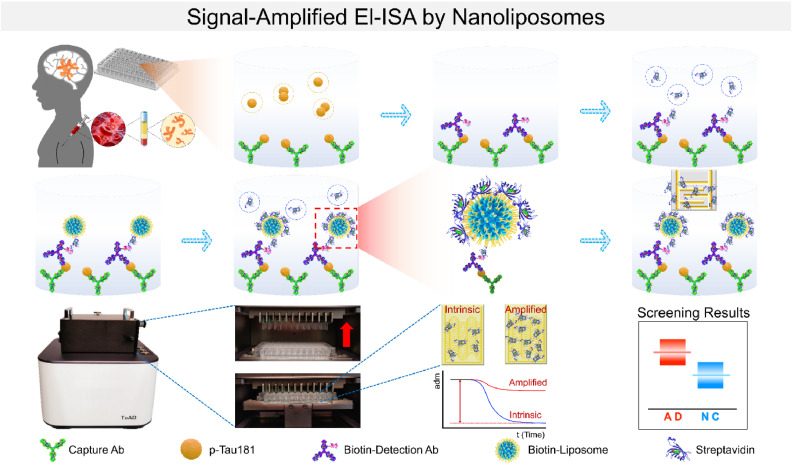
The exact sequence depends on the assay format and manufacturer’s instructions. A typical immunoassay workflow may include the following stages:
Stage 1: Prepare Samples and Reagents
Confirm that samples, calibrators, controls, and assay reagents meet the specified preparation and storage requirements.
Stage 2: Introduce the Sample
The sample is added to the assay system according to the validated procedure. Accurate sample volume and consistent handling are important.
Stage 3: Allow Target Recognition
The target p-tau 181 interacts with the relevant antibody system. Incubation conditions should follow the established assay procedure.
Stage 4: Complete Detection
The detection system generates a measurable response associated with target recognition. The exact chemistry depends on the selected assay technology.
Stage 5: Measure the Signal
The instrument measures the analytical signal under defined operating conditions.
Stage 6: Calculate the Concentration
The measured signal is interpreted using the assay’s calibration model. Results should be reviewed against quality-control criteria before being accepted.
This workflow provides a general framework, not a substitute for a validated kit-specific procedure. Actual reagent volumes, incubation times, temperatures, washing steps, and instrument settings must come from the applicable assay instructions.
7. Establish Calibration Procedures
Calibration connects the measured assay signal with the concentration of the target analyte.
A typical quantitative assay uses calibrators with assigned concentrations to establish a calibration curve. The instrument or analysis software then uses this relationship to estimate concentrations in study samples.
Important Calibration Considerations
Calibrator preparation: Calibrators should be handled according to the specified instructions to maintain their assigned values.
Calibration range: The selected range should cover the concentrations relevant to the research application.
Curve fitting: The calibration model should be appropriate for the assay’s validated response characteristics.
Calibration verification: Laboratories should establish procedures for checking calibration performance and identifying unexpected changes.
Quality-control assessment: Control materials should be used to evaluate whether the analytical run meets predefined acceptance criteria.
If a sample produces a result outside the validated measuring range, the laboratory should follow the assay’s established procedure for dilution or repeat analysis. Extrapolation beyond the validated range should not be assumed to provide reliable quantitative results.
8. Validate Analytical Performance
Analytical validation determines whether the developed procedure performs adequately for its intended purpose. Validation should be planned before routine study measurements begin.
Precision
Precision describes the agreement between repeated measurements. It can be assessed through replicate testing within a run and across multiple runs, days, operators, or reagent lots.
Standard deviation and coefficient of variation are commonly used to describe measurement variability.
Accuracy and Bias
Accuracy concerns how closely measured results agree with an accepted reference or target value. Where suitable reference materials or comparison methods are available, laboratories can use them to evaluate bias.
Analytical Sensitivity
Sensitivity assessment includes determining the assay’s ability to detect low analyte concentrations. Relevant characteristics may include the limit of blank, limit of detection, and limit of quantification.
These terms describe different analytical capabilities and should not be treated as interchangeable.
Specificity
Specificity evaluates whether the assay measures the intended p-tau 181 target without unacceptable interference or cross-reactivity.
Linearity and Measuring Range
Researchers should assess whether the assay produces an appropriate quantitative response across the claimed measuring interval. Dilution studies and other suitable experiments may help characterize this performance.
Interference
Potential interfering substances should be evaluated when relevant to the sample matrix and intended research use.
Validation criteria should be defined in advance and should reflect the assay format, study requirements, and applicable laboratory guidance.
9. Design Repeatability and Reproducibility Experiments
A developed protocol should demonstrate that measurements remain consistent under the conditions expected during laboratory use.
Repeatability Testing
Repeatability studies assess replicate measurements under the same conditions, typically using the same instrument, operator, reagent lot, and analytical run.
Testing samples at different concentration levels can help identify whether variability changes across the measuring range.
Reproducibility Testing
Reproducibility studies introduce relevant changes in testing conditions. Depending on the study objective, these may include:
- Different operators
- Separate analytical days
- Multiple reagent lots
- Different instruments
- Different laboratories
The study design should distinguish the sources of variation being evaluated. This helps researchers determine whether an assay is suitable for use across the intended laboratory environment.
10. Establish Quality-Control Procedures
Quality control helps ensure that the assay continues to perform consistently after development and validation.
Use Appropriate Control Materials
Control samples should cover relevant concentration levels where possible. Their results should be assessed against predefined acceptance limits.
Monitor Control Trends
Control charts can help identify shifts, trends, and unexpected changes in assay performance over time.
Track Reagent Lots
Record reagent lot numbers and evaluate new lots according to established laboratory procedures.
Maintain Instruments
Routine maintenance and performance checks can help prevent instrument-related variation.
Document Deviations
Unexpected results, failed controls, procedural changes, and corrective actions should be documented. Clear records support troubleshooting and reproducibility.
11. Define Result Calculation and Interpretation
The protocol should explain how raw instrument signals are converted into reported concentrations.
For quantitative assays, the calculation process generally involves applying the appropriate calibration model and reviewing the resulting values against the validated measuring range.
Researchers should also define how to handle:
- Results below the limit of quantification
- Results above the upper measuring limit
- Samples requiring dilution or repeat testing
- Failed quality-control results
- Missing or invalid measurements
- Replicate results that exceed acceptance criteria
Results should be reported with appropriate units and relevant information about the assay method, sample matrix, and analytical conditions.
P-tau 181 concentrations should be interpreted within the context of the research design. A biomarker result alone does not establish a clinical diagnosis.
12. Create Standard Operating Procedures
Once the assay workflow has been evaluated, the laboratory should document it in a standard operating procedure (SOP).
A useful SOP generally includes:
- Purpose and scope of the method
- Sample types and acceptance requirements
- Required equipment and reagents
- Reagent storage and preparation instructions
- Sample collection and processing procedures
- Assay workflow and instrument requirements
- Calibration and quality-control procedures
- Result calculation and reporting requirements
- Troubleshooting guidance
- Safety, documentation, and waste-handling requirements
The SOP should be reviewed periodically and updated when validated procedures, equipment, or reagent systems change.
Common Challenges in p-tau 181 Protocol Development
Several issues can affect assay performance during development and routine use.
| Challenge | Potential impact | Practical consideration |
|---|---|---|
| Antibody cross-reactivity | Reduced target specificity | Evaluate recognition of related tau forms |
| Sample degradation | Altered measured concentrations | Standardize collection and storage |
| Pipetting variation | Inconsistent reaction volumes | Use calibrated equipment and trained operators |
| Calibration instability | Differences in reported concentrations | Monitor calibrators and control materials |
| Reagent lot variation | Changes in assay response | Evaluate new lots before use |
| Matrix interference | Biased or inconsistent measurements | Validate performance in the intended sample matrix |
| Instrument variation | Differences between analytical runs | Perform maintenance and performance checks |
| Inadequate validation | Unrecognized analytical limitations | Assess relevant performance characteristics systematically |
A structured troubleshooting process helps laboratories identify whether unexpected results originate from sample handling, assay chemistry, calibration, or instrumentation.
Choosing Equipment for a p-tau 181 Research Workflow
Equipment selection should be based on the intended assay format and its validated compatibility with the required reagents.
For laboratories considering chemiluminescence-based workflows, relevant factors include automation, throughput, calibration functionality, signal detection, maintenance requirements, and quality-control capabilities.
The SHINE i2910 Chemiluminescence Immunoassay Analyzer is one example of an instrument that laboratories may review when evaluating chemiluminescence platforms. Before adopting any analyzer for p-tau 181 measurement, researchers should confirm that the intended assay reagents and protocol are supported and that performance has been established for the specific application.
An instrument’s general analytical capabilities should not be interpreted as proof that every biomarker assay is compatible with it.
Best Practices for Successful Protocol Development
A reliable development process benefits from a combination of careful planning, controlled experimentation, and thorough documentation.
- Define the research objective before selecting the assay format.
- Confirm antibody specificity for the intended phosphorylated tau target.
- Use sample types supported by the assay’s validation data.
- Standardize sample collection, processing, and storage.
- Follow manufacturer instructions for reagent preparation and assay operation.
- Establish suitable calibration and quality-control procedures.
- Evaluate precision at multiple concentration levels.
- Investigate analytical sensitivity, specificity, and measuring range.
- Assess potential matrix effects and interfering substances.
- Document the complete workflow in an SOP.
- Review performance whenever relevant reagents, instruments, or procedures change.
These practices help establish a consistent analytical process and make research results easier to evaluate and reproduce.
Conclusion
Developing a p-tau 181 assay protocol requires a systematic approach that connects research objectives with assay selection, antibody characterization, sample preparation, reagent handling, calibration, validation, and quality control.
Each stage contributes to the reliability of the final measurement. A clearly documented workflow, supported by repeatability and reproducibility studies, helps laboratories identify analytical limitations and reduce avoidable variation.
By defining performance requirements early and validating the complete procedure under relevant conditions, research laboratories can build a more dependable foundation for investigating p-tau 181 and its relationship with Alzheimer’s disease and other neurodegenerative processes.