Modern communication and radio frequency (RF) systems depend on electronic components that can respond quickly to changing electrical signals. From wireless communication devices and radar equipment to satellite systems and high-speed data transmission networks, fast switching is essential for maintaining signal accuracy and reliable performance. Conventional semiconductor components may not always meet the speed and frequency requirements of these applications. Specialized high-frequency diodes are therefore used to control, detect, rectify, and switch signals operating at high frequencies.
A high-frequency diode is designed to operate effectively in circuits where rapid signal transitions, low capacitance, and minimal switching delays are important. Its semiconductor structure and electrical characteristics allow it to handle high-speed signals in applications such as RF switching, signal detection, and frequency conversion. Selecting the appropriate High Frequency Diode can help engineers improve circuit response, reduce unwanted signal distortion, and develop communication systems that operate reliably at demanding frequencies.
What Is a High Frequency Diode?
A high-frequency diode is a semiconductor device designed for applications involving rapidly changing electrical signals. Like other diodes, it controls current flow according to its electrical characteristics. However, high-frequency versions are optimized to minimize unwanted effects that become increasingly important as operating frequency rises.
At high frequencies, parasitic capacitance, junction behavior, reverse recovery time, and package inductance can affect circuit performance. A diode with unsuitable characteristics may introduce signal loss, switching delays, or distortion.
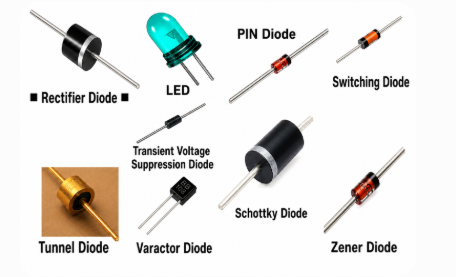
High-frequency diodes are available in different semiconductor technologies and configurations. Depending on the application, engineers may use Schottky diodes, PIN diodes, fast-recovery diodes, or specialized RF detector diodes.
Why Fast Switching Is Important in Communication and RF Systems
Communication systems transmit information through electrical or electromagnetic signals that may change extremely quickly. Electronic circuits must process these signals without introducing excessive delays or distortion.
Fast switching helps ensure that electronic components respond accurately to changing signal conditions. It is especially important in systems that operate at high frequencies or require precise signal control.
Some major reasons fast switching matters include:
- Signal accuracy: Rapid response helps circuits follow changing signal waveforms.
- Reduced distortion: Appropriate diode characteristics help minimize unwanted changes to signals.
- Efficient signal processing: Fast semiconductor operation supports high-speed electronic functions.
- Reliable communication: Proper signal control helps maintain consistent system performance.
- Improved circuit response: Low switching delays are valuable in RF and microwave applications.
How High-Frequency Diodes Support Fast Switching
The switching performance of a high-frequency diode depends on its semiconductor construction and electrical parameters. Several characteristics help these components operate effectively in high-speed circuits.
1. Low Junction Capacitance
Junction capacitance is an important consideration in high-frequency circuit design. When a diode has excessive capacitance, it can interfere with rapidly changing signals and affect the circuit’s frequency response.
High-frequency diodes are often designed with low junction capacitance to reduce signal loading. This allows them to operate more effectively in RF circuits, where even small parasitic effects can influence performance.
Low capacitance is particularly useful in switching networks, signal detectors, and high-frequency communication interfaces.
2. Short Switching and Recovery Times
When a conventional PN-junction diode changes from forward conduction to reverse blocking, stored charge may take time to disappear. This behavior is known as reverse recovery.
Fast-recovery and other specialized diode designs reduce this delay, making them suitable for circuits that require rapid switching transitions.
For RF applications, however, reverse recovery is only one part of the overall performance picture. Junction capacitance, package parasitics, and the diode’s specific operating mode must also be evaluated.
3. Low Forward Voltage Drop
Some high-frequency diode technologies, particularly Schottky diodes, offer a relatively low forward voltage drop compared with conventional silicon PN-junction diodes.
This characteristic can reduce conduction losses and improve the efficiency of certain detection, rectification, and switching circuits.
Lower forward voltage is especially beneficial in low-level signal detection, where small signal amplitudes make diode conduction characteristics important.
4. Reduced Parasitic Effects
At high frequencies, unwanted inductance and capacitance can affect the performance of even a carefully designed circuit.
High-frequency diode packages are often developed to minimize these parasitic effects. Compact package structures and short electrical connections can help improve circuit behavior, although the PCB layout and surrounding components remain equally important.
Common Types of High-Frequency Diodes
Different diode technologies are used in communication and RF systems according to their switching characteristics and intended functions.
1. Schottky Diodes
<text color=”secondary” size=”sm”>Common uses: RF detection, mixing, and high-speed switching</text>
Schottky diodes use a metal-semiconductor junction rather than a conventional PN junction. They typically have a low forward voltage drop and low charge-storage effects, making them useful in many high-frequency applications.
Common applications include:
- RF signal detectors.
- Microwave mixers.
- High-speed switching circuits.
- Low-level signal rectification.
- Frequency conversion circuits.
Their reverse leakage current and maximum reverse voltage should be considered when selecting a device.
2. PIN Diodes
<text color=”secondary” size=”sm”>Common uses: RF switching, attenuation, and signal routing</text>
A PIN diode contains an intrinsic semiconductor region between its P-type and N-type regions. At RF frequencies, its behavior can be controlled through forward and reverse biasing.
PIN diodes are widely used in RF switching networks because their resistance and impedance characteristics can be controlled by adjusting the applied bias.
Typical applications include antenna switching, RF attenuators, and signal routing systems.
3. Fast-Recovery Diodes
<text color=”secondary” size=”sm”>Common uses: High-speed rectification and switching power circuits</text>
Fast-recovery diodes are designed to reduce the time required to stop conducting after the applied voltage reverses.
They are commonly used in high-frequency power conversion circuits, switching power supplies, and other applications where reverse recovery losses can affect efficiency.
4. Varactor Diodes
<text color=”secondary” size=”sm”>Common uses: Frequency tuning and RF signal control</text>
Varactor diodes operate as voltage-controlled capacitors when reverse-biased. Their junction capacitance changes with the applied reverse voltage.
This property makes them useful in voltage-controlled oscillators, frequency synthesizers, and electronically tuned RF circuits.
Although their main function is not conventional fast switching, they play an important role in controlling high-frequency signals.
Applications in Modern Communication and RF Systems
High-frequency diodes support several important functions in modern communication equipment. Their specific roles depend on the type of diode and the electrical design of the system.
RF Signal Detection
Schottky diodes are frequently used in RF detector circuits to convert high-frequency signals into measurable voltage levels. These circuits help identify signal strength and support measurement, monitoring, and communication functions.
RF Switching Networks
PIN diodes can control the routing of RF signals between different circuit paths. They are used in antenna systems, transmit-receive switching arrangements, and communication equipment that requires electronic signal selection.
Microwave Frequency Mixing
Diodes can be used in mixer circuits to combine signals and generate new frequency components. This process is important in receivers, transmitters, and frequency conversion systems.
Wireless Communication Equipment
Wireless devices require efficient signal processing and frequency control. High-frequency diodes support detection, switching, and tuning functions in equipment used for cellular communication, Wi-Fi, and other wireless technologies.
Radar and Satellite Systems
Radar and satellite communication equipment often operates at microwave frequencies. Specialized diodes can support RF signal routing, detection, and frequency-control functions in these systems.
Important Electrical Characteristics to Consider
Selecting a suitable high-frequency diode requires careful evaluation of its datasheet specifications. A diode that performs well at one frequency or power level may not be suitable for another application.
| Electrical characteristic | Importance in circuit design |
|---|---|
| Junction capacitance | Influences signal loading and high-frequency response |
| Reverse recovery time | Affects switching losses in relevant diode applications |
| Forward voltage drop | Influences conduction losses and detection sensitivity |
| Reverse voltage rating | Determines the maximum permitted reverse voltage |
| Forward current rating | Defines safe current-handling capability |
| Package inductance | Can affect high-frequency performance |
| Operating frequency | Helps determine suitability for the intended signal range |
| Thermal characteristics | Influence reliability and power-handling capability |
Engineers should review these parameters together rather than focusing on a single specification.
Challenges of Using High-Frequency Diodes
Although high-frequency diodes provide important performance advantages, their use also involves certain design challenges.
Signal Loss and Impedance Matching
Incorrect impedance matching can cause signal reflections and reduce the amount of power transferred between circuit stages. The diode and its surrounding network must be designed to work with the required system impedance.
Thermal Management
High-frequency operation can generate heat through conduction losses, switching losses, and other circuit effects. Excessive temperature may change diode characteristics and affect long-term reliability.
PCB Layout Sensitivity
At RF frequencies, PCB traces, ground connections, and component spacing can influence circuit behavior. Poor layout practices may introduce parasitic inductance, capacitance, and unwanted coupling.
Component Selection
Different diode technologies serve different purposes. For example, a Schottky diode may be suitable for RF detection, while a PIN diode may be a better choice for RF switching. Selecting a component without considering its intended function can lead to poor circuit performance.
Best Practices for Integrating High-Frequency Diodes
Proper integration is essential for achieving reliable high-frequency operation. Engineers should begin by identifying the operating frequency range, signal level, and switching requirements of the application.
The diode’s datasheet should then be checked for capacitance, switching behavior, current limits, reverse voltage, and package characteristics. PCB layout should minimize unnecessary trace lengths and provide appropriate grounding and impedance control.
For RF switching networks, the biasing circuit must also be designed carefully to prevent unwanted interference with the signal path. In detection circuits, the diode’s sensitivity and response characteristics should match the expected signal amplitude.
Finally, practical testing with suitable RF measurement equipment can help verify insertion loss, isolation, switching response, and overall circuit performance.
Conclusion
High-frequency diodes play an important role in modern communication and RF systems by supporting fast switching, signal detection, frequency conversion, and electronic signal control. Their specialized electrical characteristics, including low junction capacitance, suitable switching behavior, and reduced parasitic effects, make them valuable in applications where signal speed and accuracy are essential.
Different technologies, including Schottky, PIN, fast-recovery, and varactor diodes, serve different purposes in high-frequency circuit designs. By understanding their operating principles and carefully evaluating their electrical specifications, engineers can select suitable components for reliable communication equipment, wireless devices, radar systems, and RF applications.