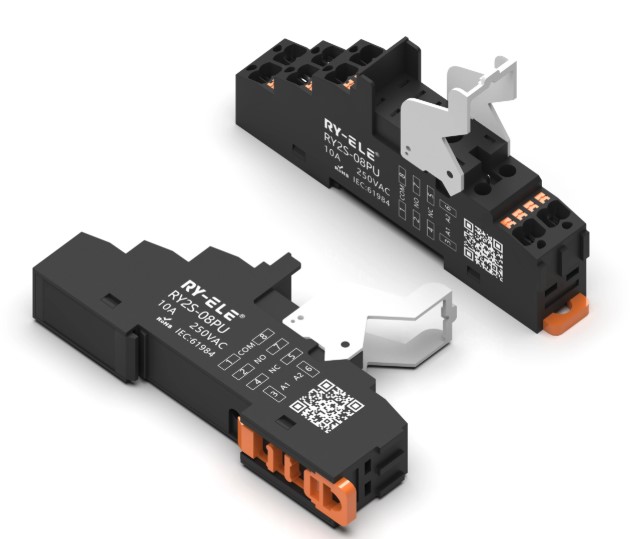
Industrial control systems rely on dependable electrical switching for machines, sensors, actuators, motors, and other equipment. A relay provides the switching function, while its connection to the control board also deserves careful attention. The right socket can simplify installation, maintenance, and relay replacement.
A PCB relay socket provides a dedicated interface between a relay and the printed circuit board. RY-ELE supplies relay-related components for industrial control applications, giving designers options when they need practical and serviceable relay connections.
What Does a Relay Socket Do?
A relay socket connects the relay terminals with the electrical paths on a PCB. It also provides mechanical support that helps keep the relay correctly positioned during equipment operation.
Unlike a relay that sits directly on the board, a socketed arrangement allows technicians to remove the relay without desoldering the component from the PCB.
This approach can make maintenance more straightforward, especially in control systems that operate for extended periods.
When Is a PCB Relay Socket a Good Choice?
A socket makes particular sense when a control system needs convenient relay replacement or regular maintenance. It can also help when designers want to separate the replaceable relay from the permanent PCB connection.
Common situations include:
Equipment That Requires Frequent Maintenance
Industrial machinery often needs periodic inspection and servicing. A socket can allow technicians to replace a relay quickly when troubleshooting reveals a faulty switching component.
This reduces the need to heat solder joints or remove the PCB during routine relay replacement.
Systems With Replaceable Relays
Some control systems use relays as serviceable components. A socket provides a practical connection that supports removal and installation without permanently attaching the relay to the PCB.
This arrangement may simplify inventory management because technicians can replace individual relays while keeping the socket installed.
Applications With Limited Downtime
Production equipment may need to return to operation quickly after a component failure. A socketed relay can help shorten replacement procedures when the relay itself requires servicing.
The exact time savings depend on the equipment design and accessibility, but easier component replacement remains a useful advantage.
What Factors Should You Consider?
Using a socket does not automatically improve every control system. Designers should determine whether the additional component fits the application’s electrical and mechanical requirements.
Important considerations include:
- Relay type and pin configuration
- Coil voltage and current
- Contact ratings
- PCB space
- Operating temperature
- Vibration levels
- Installation requirements
- Maintenance frequency
Matching the socket with the relay is essential. The pin arrangement, dimensions, and electrical connections should correspond with the selected relay.
How Does a Socket Help With Maintenance?
Maintenance represents one of the strongest reasons to use a relay socket. A directly mounted relay may require desoldering before replacement, which takes more time and may place stress on the PCB.
A socket keeps the board connection in place while allowing the relay to come out separately. Technicians can then install a compatible replacement with less disruption to the board.
This design also helps simplify troubleshooting when a relay forms part of a larger industrial control circuit.
When Might a Direct PCB Relay Make More Sense?
Not every application needs a socket. Equipment with limited service requirements may use a relay mounted directly to the PCB when the design and relay type support that approach.
Direct mounting can reduce the number of components and may offer a compact solution for certain applications. Designers should compare space, maintenance needs, cost, and expected service life before deciding.
The choice depends on the priorities of the complete control system.
Consider the Operating Environment
Industrial equipment may encounter vibration, temperature changes, dust, humidity, and continuous operation. These conditions can affect electrical connections and mechanical components.
A suitable socket should match the expected environment and relay operating conditions. Designers should also consider enclosure protection, PCB mounting strength, and thermal management.
Applications with significant vibration deserve particular attention to relay retention and socket stability.
Why Pin Compatibility Matters
A socket must match the relay’s terminal arrangement. Using a socket with the wrong pin configuration may prevent correct installation or create incorrect electrical connections.
Before purchasing components, engineers should review the relay datasheet and compare it with the socket specifications.
Check the number of terminals, pin spacing, contact arrangement, coil connections, and physical orientation. This simple verification step can prevent compatibility problems during assembly.
PCB Layout Considerations
The socket footprint becomes part of the overall PCB design. Designers need to reserve enough space for the socket, relay, surrounding components, and service access.
Trace routing also matters. High-current paths may require suitable trace widths, while adequate spacing can help maintain electrical separation between circuits.
A well-planned layout can make the socket easier to install and the relay easier to access during maintenance.
How RY-ELE Supports Industrial Control Applications
RY-ELE offers relay and control components for electrical applications that require dependable switching and practical system integration.
When choosing a socket, engineers can compare relay specifications, mounting requirements, pin configuration, and operating conditions to identify a suitable solution for their equipment.
The right combination of relay and socket can support easier maintenance while maintaining a stable connection between the relay and control board.
A Practical Decision Guide
Consider using a socket when:
- Relays require periodic replacement.
- Equipment downtime needs to remain low.
- Technicians need convenient access to switching components.
- The relay serves as a replaceable service part.
- The PCB design provides adequate room for the socket.
- The socket and relay have matching electrical and mechanical specifications.
A direct PCB-mounted relay may suit applications where replacement is rare and the design prioritizes a simple, compact assembly.
Conclusion
A PCB relay socket makes sense when an industrial control system benefits from easier relay replacement, convenient maintenance, and a reliable connection between the relay and PCB.
The decision should account for pin configuration, electrical ratings, available space, environmental conditions, mechanical stability, and service requirements. By evaluating these factors before PCB production, engineers can select a relay connection method that fits the needs of their equipment.
For industrial control designs that require practical relay integration, RY-ELE provides components that can help engineers develop reliable and serviceable electrical control systems.